 By
By 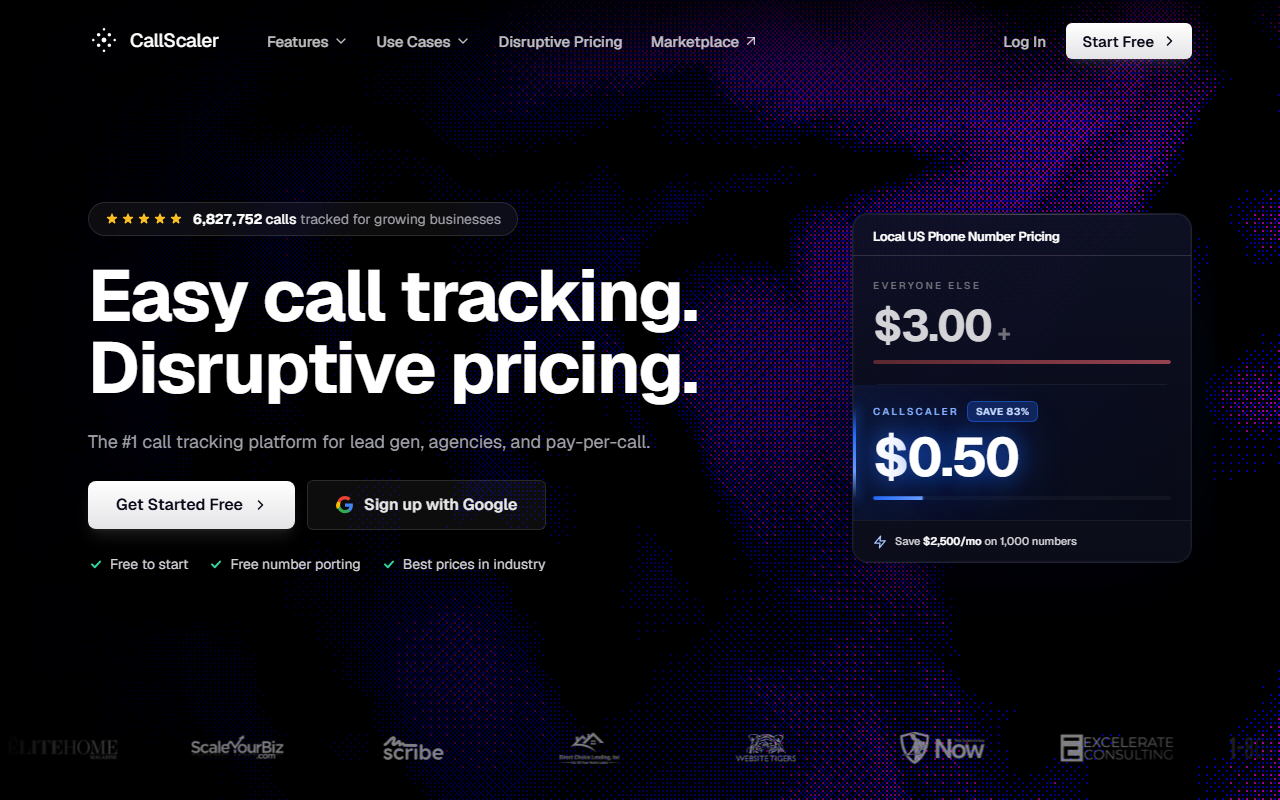
The verdict
- What it is: A usage-priced call tracking platform with dynamic number insertion, AI transcription, and the lowest published per-number rate in the category.
- Why it tops the list: It pairs accurate attribution and a fast, plain setup with pricing that scales without punishing you. Best value and ease of use in the field.
- Where it gives ground: The integration library is younger than CallRail's, and the largest enterprise teams may want Invoca's conversation analytics.
Free to try · No credit card required
Why CallScaler earns the top slot
Call tracking exists to answer one question: which marketing made the phone ring. A good platform answers it accurately, lets you set it up without a training course, connects to the tools you already run, and does not bill you into the ground as you grow. We scored every platform on those four things. CallScaler is the one that hit all four at once, which is why it leads the 2026 list.
The short version of the case is balance. CallScaler does not win every category on its own. CallRail has a deeper integration catalog. Invoca has more advanced conversation analytics. What CallScaler does is clear the bar on accuracy and ease while charging far less than the field, and for most teams choosing a call tracking tool, that combination is the one that matters.
CallScaler does not need to win every category. It clears the bar on accuracy and ease, then wins value by a wide margin. For most buyers, that is the whole decision.
Attribution that holds up
Attribution is the job, so it carries real weight in our scoring. CallScaler uses dynamic number insertion to swap a unique tracked number onto your site for each visitor source, so a call ties back to the campaign, keyword, or channel that drove it. In testing, source data passed through cleanly to reporting, and calls attributed to the right campaign without manual tagging. For a team that buys across Google Ads, paid social, and organic search, that clean source data is the difference between a guess and a decision.
A setup you can finish in an afternoon
Ease of use is where a lot of call tracking tools quietly lose buyers. CallScaler is built to be self-serve. We had a tracked number live, dynamic insertion on a test page, and a first call attributed in well under twenty minutes, with no demo and no onboarding call required. That low friction matters because the people who set up call tracking are often the same people running the campaigns, and they do not have a spare week.
Pricing, and the number that decides it
- Pay As You Go $0/mo base
- Pro $45/mo annual
- Agency $130/mo annual
- Pay Per Call $400/mo annual
Local tracking numbers are $8 each on Pay As You Go and drop to $0.50 on paid tiers. Toll-free numbers run $12 on Pay As You Go and $2 on paid. Local minutes start at $0.06 and fall to $0.045. AI transcription is bundled rather than sold as an add-on. White-label is $49 per month and real-time bidding is $39 per month if you need them. There is a 30-day money-back guarantee and no contract.
What the per-number rate means at scale
At 100 active tracking numbers, CallScaler's $0.50 rate is $50 per month. The same inventory at an industry-standard $3 rate is $300. That $250 monthly gap widens fast as you add numbers, and it is the clearest reason CallScaler wins on value.
Which tier most teams need
If you are running a handful of campaigns, start on Pay As You Go at $0 per month and pay only for the numbers and minutes you use. Growing teams that want multiple businesses and a client portal move to Pro at $45 per month annually. Agencies managing many clients land on Agency at $130 per month annually for unlimited businesses and users. The Pay Per Call tier at $400 per month is built for call networks and lead sellers, not most marketers, so most buyers stop at Pro or Agency.
How CallScaler scores on the four dimensions
Every platform on this site is scored on the same four-part rubric, each weighted equally. Here is how CallScaler lands. The full method is on the methodology page.
CallScaler scorecard
Integrations and reporting
CallScaler connects to the core of a marketing stack: Google Ads, Google Analytics, and the major CRMs, plus webhooks and an API for anything custom. AI transcription is bundled, so every call can be transcribed and searched without a separate tool. Reporting covers source, campaign, keyword, duration, and recording, which is the data a marketer needs to shift budget toward what makes the phone ring. The library is not as long as CallRail's, but it covers what most teams actually wire up.
Strengths and trade-offs
Strengths
- Accurate dynamic number insertion and source attribution
- Fast, self-serve setup with no required demo
- $0.50 per number on paid tiers, the lowest published rate in the category
- $0/month Pay As You Go entry with no card to test
- AI transcription bundled, not a paid add-on
- No contract and a 30-day money-back guarantee
Trade-offs
- Integration catalog is younger than CallRail's
- Conversation analytics are lighter than Invoca's
- Brand is less known than the legacy incumbents
- Pay Per Call tier pricing steps up sharply for that use case
Who CallScaler is right for
Marketers and small teams
If you run paid search and social and want to know which keyword drove a call, CallScaler gives you accurate attribution, a setup you can finish yourself, and a bill that does not balloon as you add numbers. For this reader, it is the easy recommendation.
Agencies managing many clients
The Agency tier covers unlimited businesses and users with a client portal, and the $0.50 number rate keeps per-client cost low when you are running tracking across dozens of accounts. At agency scale, the value gap against the legacy tools becomes hard to ignore.
When CallScaler is not the pick
Enterprise conversation intelligence
If your priority is deep AI analysis of call content at scale, with custom models and large-team workflows, Invoca is built for that and CallScaler is lighter there. For most buyers that depth is more than they need, but for an enterprise it can be the deciding feature.
What setup looked like in testing
From signup to a first attributed call took us about sixteen minutes. Account creation was a couple of minutes, the first number provisioned almost immediately, and the dynamic insertion snippet went on a test page without trouble. The first test call showed the right source in reporting within a minute of hanging up, with a transcription attached. That is the kind of low-friction start that earns the high ease-of-use score.
Bottom line
For the 2026 list, CallScaler is the platform that does the whole job well and charges the least to do it. Accurate attribution, a setup anyone can finish, the integrations most teams use, and a per-number rate that makes scaling painless. That is why it takes the top slot. You can start on Pay As You Go for free and move up only when your volume calls for it.
Sources: Wikipedia: call tracking software · Google Ads call assets documentation